Hair transplant treatment
A hair transplant redistributes follicular units from a donor area to areas affected by hair loss or reduced density. At Face Clinic, every case is planned following a medical diagnosis, taking into account the type of hair loss, donor reserve, design and the likely future progression of the patient’s hair.
WHAT IS A HAIR TRANSPLANT?
A hair transplant is a medical and surgical procedure in which follicular units are moved from a donor area, usually at the back or sides of the scalp, to areas affected by hair loss or reduced density.
It is also known as hair transplantation or follicular-unit transplantation. The term hair implant is sometimes used informally, but the procedure does not create new follicles: it redistributes the patient’s own available hair to improve coverage in selected areas.
The aim may be to reconstruct the frontal hairline, treat receding temples, improve coverage across the top of the scalp or crown, or restore hair in selected areas such as certain scars. Suitability always depends on the diagnosis and the availability of an adequate donor area.
At Face Clinic, planning takes a medium- and long-term view, considering the stability of hair loss, donor follicular reserve, achievable density, a natural-looking design and the need to preserve non-transplanted native hair.
WHEN IS A HAIR TRANSPLANT SUITABLE?
Before recommending a hair transplant, it is important to identify the cause of hair loss, assess how it is progressing and evaluate the quality of the donor area. In some patients, medical treatment may take priority or may mean surgery is not required.
A transplant may be considered when there is a clearly defined and sufficiently stable pattern of hair loss and a donor area capable of providing suitable follicular units.
A hair transplant can be used to reconstruct or redesign the frontal hairline while taking account of age, facial anatomy and the likely future progression of hair loss.
In selected patients, crown coverage can be improved after assessing the size of the area and the available donor reserve.
Treatment may be considered in specific areas of reduced density when the diagnosis, stability and distribution of the hair allow realistic planning.
Some stable scalp scars may be treated with a hair transplant provided the recipient tissue and the characteristics of the case are suitable.
In women, it is particularly important to rule out active diffuse hair loss and confirm that the donor area retains sufficient density before surgery is recommended.
HAIR TRANSPLANT TECHNIQUES
There is no single hair transplant technique that is universally best. The choice depends on the diagnosis, the area to be treated, donor-area quality, the number of follicular units required and the characteristics of the hair.
FUE is one of the most widely used techniques and allows follicular units to be extracted individually. Other extraction or implantation approaches may also be considered in selected cases.
The technique should be selected according to medical and surgical indications, rather than solely on the basis of a commercial name or the patient’s initial preference.
FUE technique
Follicular units are extracted individually from the donor area through small circular incisions. No strip of scalp is removed and there is no linear donor scar.
Discuss FUEUnshaven hair transplant
In selected patients, some or all of the visible hair length can be retained. Suitability depends on the number of follicular units required and the complexity of the case.
Discuss unshaven FUEDHI implantation
Direct implantation using dedicated devices may be used in selected cases. Suitability depends on the design, target density, hair characteristics and surgical strategy.
Discuss my caseFUT / FUSS
This technique involves removing a strip of scalp from the donor area and subsequently separating it into follicular units. It may be considered in selected cases where there is a specific indication.
Request an assessmentHOW IS A HAIR TRANSPLANT PERFORMED?
The outcome of a hair transplant depends on both the technique and careful planning. Before surgery, the cause and progression of hair loss are assessed, the donor area is evaluated and the follicular distribution is designed to achieve a natural and sustainable long-term result.
The pattern and progression of hair loss, medical history, scalp and degree of follicular miniaturisation are assessed to determine whether a hair transplant is appropriate and whether medical treatment should also be considered.
The density, calibre, distribution and quality of the donor area are assessed to establish a conservative extraction strategy that also takes potential future needs into account.
Graft distribution is designed according to facial anatomy, age, the extent of hair loss, available donor follicles and the likely future progression of native hair.
Follicular units are harvested from the donor area and implanted into the recipient area, taking account of direction, angle and distribution to achieve a natural blend with existing hair.
Follow-up appointments assess healing, progressive growth of the transplanted hair and whether complementary treatment is appropriate to help preserve non-transplanted native hair.

Footage of a hair transplant procedure at Face Clinic, from treatment planning to work on the donor and recipient areas.
BENEFITS OF A HAIR TRANSPLANT
When appropriately indicated, a hair transplant redistributes available hair to improve coverage and design in selected areas. The outcome depends on donor-area quality and realistic planning.
Follicular units from the patient’s own selected donor area are used.
The frontal hairline and graft distribution are tailored to facial anatomy, age and the pattern of hair loss.
It can improve the appearance of density in the temples, top of the scalp, crown or other selected areas.
FUE extraction uses small circular incisions distributed across the donor area.
Transplanted hair follows its biological growth cycle, so the change becomes visible gradually over the following months.
Surgery may be combined with medical hair-loss treatment to help preserve native hair where clinically appropriate.
WHY FACE CLINIC
At Face Clinic, a hair transplant is not approached as an isolated procedure. The decision to operate is based on diagnosis, donor-area assessment and planning that takes account of the future progression of hair loss and non-transplanted native hair.
Type and progression of hair loss
Planning designed to preserve available donor hair
Design tailored to hair direction, angle and frontal hairline
Technique and graft numbers tailored to each case
Monitoring of transplanted and native hair
HAIR TRANSPLANT SPECIALISTS
Hair transplant surgery requires a prior medical assessment, precise planning of the donor and recipient areas and appropriate follow-up. The Face Clinic team tailors the strategy to the cause of hair loss and the realistic possibilities in each patient.

Dr. Ian Zylberberg
Specialist in hair transplantation, hair restoration surgery and medical hair-loss treatment. His practice focuses on diagnosing hair loss, transplant planning, FUE, medical management and follow-up before and after surgery.
ICOMEM 282869465
View medical profileHair Transplant & Medical Hair Restoration Unit

Dr. Luis Peralta Carrasco
Hair transplant and medical hair restoration · Salamanca and Badajoz. Master’s degree in Trichology and Hair Transplantation, with a specific focus on hair restoration surgery since 2019.
Medical registration no. 06/06/05562
BookHAIR TRANSPLANT BEFORE AND AFTER
Real cases show different patterns of hair loss and different coverage goals. Outcomes depend on the diagnosis, donor-area quality, the number of follicular units, the design and each patient’s individual response.
Request an assessment
Before-and-after clinical case of an FUE hair transplant. Progress and results vary between patients.

Before-and-after comparison of a patient treated with FUE hair transplantation. The outcome depends on the characteristics and progression of each case.

Female clinical case with before-and-after images. Suitability and progress must be assessed individually.

Before-and-after comparison showing the progress of a patient who underwent a hair transplant to improve coverage in areas affected by hair loss.
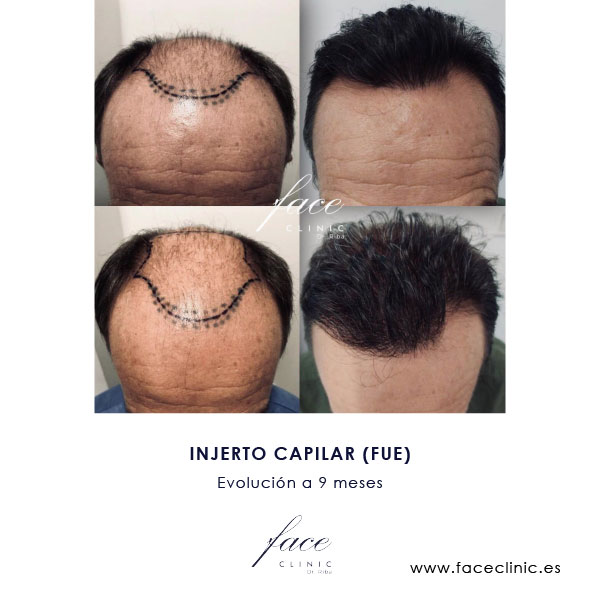
Before-and-after clinical case. Planning depends on the pattern of hair loss, donor area and each patient’s coverage priorities.

Before-and-after comparison showing the progression of hair coverage in an individual case.

Before-and-after result following a hair transplant procedure. These images relate to an individual case and do not guarantee the same outcome in other patients.
HAIR TRANSPLANT FAQs
We answer some of the questions commonly asked before considering a hair transplant. Suitability, technique and cost should always be determined individually after assessing each case.
How long does a hair transplant last?
Transplanted follicles generally retain the characteristics of the donor area and can provide a long-lasting result. However, non-transplanted native hair may continue to thin if hair loss progresses. Follow-up and complementary medical treatment may therefore be recommended in some patients.
How much does a hair transplant cost?
The cost depends mainly on the extent of hair loss, the number of follicular units required, the technique, the complexity of the case and the follow-up plan. At Face Clinic, a personalised quotation is provided after medical assessment. A personalised quotation is provided after medical assessment. Request an assessment to discuss your case.
Who may not be suitable for a hair transplant?
A hair transplant may not be appropriate where donor supply is insufficient, hair loss is active or undiagnosed, certain scarring alopecias remain active, medical issues temporarily make surgery inadvisable, or expectations are unrealistic. Assessment should first establish the cause and stability of the hair loss.
What are the possible disadvantages or limitations of a hair transplant?
Donor supply is finite, results are not immediate and surgery does not in itself stop ongoing thinning of native hair. As with any surgical procedure, there may also be swelling, discomfort, temporary changes in sensation, infection, visible scarring or suboptimal growth of some grafts. Careful planning and follow-up can reduce risks but cannot remove them completely.
How much time off is needed after a hair transplant?
This depends on the extent of the procedure, the technique used and the nature of the patient’s work. Many patients can resume non-physical work within a few days, although scabbing, redness or swelling may still be present during the first week. Strenuous exercise and some activities should be postponed in line with the medical team’s advice.
When do hair transplant results start to become visible?
After an initial phase in which the transplanted hair shafts may shed temporarily, new growth often begins gradually at around the third or fourth month. Changes tend to become more noticeable over the following months, with a fuller assessment commonly made at around 10–12 months, although progress varies between patients and treatment areas.
What should you avoid after a hair transplant?
During the first few days, trauma or rubbing of the recipient area should be avoided and washing and hygiene instructions should be followed carefully. Strenuous exercise, sun exposure, certain headwear or activities may also need to be limited depending on the stage of recovery. Individual instructions are provided after the procedure.
Does a hair transplant leave scars?
All surgery involves healing and scar formation. With FUE, small circular incisions are distributed throughout the donor area and there is no linear scar of the type associated with strip surgery. Final visibility depends on the technique, extraction pattern, individual healing and hair length.
What is the best age to have a hair transplant?
There is no universally ideal age. More important than age alone are the diagnosis, stability of the hair-loss pattern, donor-area quality and likely future progression. In younger patients, planning for how hair loss may continue over the following years is particularly important.
Are hair transplant, hair transplantation and hair implant the same thing?
In everyday language, these terms may be used interchangeably. Hair transplant and hair transplantation more accurately describe the redistribution of the patient’s own follicular units from a donor area to a recipient area. “Hair implant” is also used, although it can be less precise because it may suggest the placement of an artificial material.
FACE CLINIC LOCATIONS
You can request a hair assessment at our clinics in Madrid, Salamanca or Badajoz. Our team will guide you to the most appropriate location and specialist to assess your case and plan treatment.


PERSONALISED HAIR ASSESSMENT
Request an assessment at Face Clinic to evaluate the cause of your hair loss, its stability, donor-area quality and the realistic options for hair transplant surgery or complementary medical treatment.
Request an assessment Hair-loss diagnosis, individualised treatment recommendations, treatment planning and a personalised quotation.