Chin implant

Chin implant surgery to increase the projection of an under-projected chin and balance the facial profile using standard implants or personalised 3D prostheses, following an individual assessment of bone structure and facial proportions.

Standard or 3D The implant is selected according to anatomy, the required projection and the complexity of the case
Facial planning We assess the chin, jaw, nose, lips and profile before deciding how much projection is needed and where
1–2 weeks Typical initial recovery; residual swelling and tissue adaptation improve gradually
Follow-up Post-operative reviews to monitor healing, implant position and progress

WHAT IS A CHIN IMPLANT?

A structural approach to redefining the profile

A chin implant is a facial surgery technique used to increase or redefine chin projection by placing a prosthesis over the underlying bone. The aim is not simply to “make the chin larger”, but to adjust its projection, width or contour in a controlled way so that it is better balanced with the nose, lips, jaw and neck.

The procedure can be carried out using preformed implants or, in selected cases, personalised implants designed with 3D digital planning. The choice depends on the patient’s anatomy, the correction required and the intended outcome.

It is important to distinguish an under-projected chin from a retruded jaw as a whole. Where there is a more significant skeletal discrepancy, malocclusion or imbalance between the upper and lower jaws, a chin implant may not be sufficient on its own and it may be necessary to consider bony genioplasty or orthognathic surgery.

At Face Clinic, treatment is planned after a full facial assessment. The indication is based on bone structure, occlusion, profile and the patient’s goals rather than applying the same volume or implant design to every case.

★★★★★
Google · Patient review

Six months ago I had buccal fat removal and a chin implant with a titanium prosthesis... and I could not be happier with the results.

Elisiane Braganca · Google
★★★★★
Google · Patient review

I went to Dr Riba for cheek and chin implants. My experience with Dr Riba and his team was incredible.

Roberto AriasJJ · Google
★★★★★
Google · Patient review

I am extremely happy with the results. I had chin surgery, I look like a different person, and everything went very well.

Hind Betioui · Google
★★★★★
Google · Patient review

He performed surgery for a very deep scar and I did not have symmetry in my chin.

Hayat Lahlou · Google
★★★★★
Top Doctors · Verified patient

I had 3D planning for my cheekbones and chin, and the result has a level of precision you do not get with conventional implants.

A.G. · Top Doctors
★★★★★
Google · Patient review

The result has been better and more natural than I expected. The doctor knew how to advise me to achieve excellent facial harmony.

Thomas Camarero · Google

WHEN TO CONSIDER A CHIN IMPLANT

When a receding chin affects the whole profile

An under-projected chin can alter the overall profile, make the nose appear relatively more prominent or visually shorten the chin-to-neck line. The indication for an implant should be confirmed after identifying the cause of the imbalance and ruling out problems that require a different skeletal correction.

01
Under-projected chin

When the chin sits behind the rest of the profile and a structural increase in projection is required.

02
Unbalanced profile

When the relationship between the nose, lips and chin makes the lower third of the face appear insufficiently defined.

03
Chin asymmetry

In selected cases, a personalised implant may help compensate for differences in volume or shape between the two sides.

04
Seeking a lasting change

It may be considered when a longer-lasting structural change is preferred to the effect of resorbable fillers.

05
Poor chin–neck definition

Increasing projection may improve the appearance of the cervicomental angle, although it does not replace treatment for submental fat or skin laxity when these are the main cause.

06
An implant is not always the answer

If there is mandibular retrusion, a bite problem or a significant skeletal discrepancy, bony genioplasty or orthognathic surgery may be more appropriate.

TYPES OF CHIN IMPLANT AT FACE CLINIC

From standard implants to personalised 3D designs

Not all chin implants are the same. The choice depends on the amount of projection required, bone shape, symmetry, the desired lateral extension and the complexity of the case.

At Face Clinic, options may include standard medical-grade silicone implants and personalised 3D-designed prostheses made from materials such as PEEK or titanium, depending on the surgical indication.

Material and design are not selected in isolation: they form part of a plan that considers anatomy, placement technique, stability and procedure-specific risks.

01

Standard silicone implant

A preformed prosthesis available in different sizes and configurations. It may be suitable when the anatomy allows a relatively straightforward and symmetrical correction.

Discuss my case
02

Personalised PEEK implant

A prosthesis designed around the patient’s anatomy to tailor shape, extension and projection more precisely. It is particularly considered when a case requires a specific design.

View 3D facial implants
03

Personalised titanium implant

Another option for creating an individualised prosthesis using digital planning. Its indication depends on the anatomy and the surgeon’s clinical judgement.

Request an assessment
04

When an implant is not the best option

If the problem involves the position of the chin bone itself, the whole jaw or the bite, an advancement genioplasty or orthognathic surgery may be more appropriate.

View genioplasty

HOW CHIN IMPLANT SURGERY IS PERFORMED

The process, step by step from 3D planning

Chin implant surgery begins well before the operating theatre. The outcome depends on a correct diagnosis, appropriate technique selection and precise planning of the implant’s shape and position. Operating time, anaesthesia and recovery can vary according to the type of prosthesis and whether other procedures are performed at the same time.

01 · Assessment Assess the profile and confirm that the issue is centred on the chin

Facial proportions, chin projection, jaw position, nose, lips and, when relevant, the bite are assessed to determine whether an implant is genuinely the most appropriate option.

02 · Planning Define the required projection and implant type

In selected cases, imaging and digital planning are used to design a personalised 3D prosthesis adapted to the bony contour and treatment objective.

03 · Surgery Create the pocket and position the implant over the bone

Access may be intraoral or through a submental incision, depending on the case and chosen technique. The implant is positioned over the bone and its stability and symmetry are checked.

04 · Aftercare Monitor swelling, healing and implant position

Swelling and a feeling of tightness are common during the first few days. Specific aftercare, hygiene measures, medication when required and temporary activity restrictions are advised.

05 · Follow-up Assess the result as the tissues settle

The change in profile may be visible early on, but the result should be assessed progressively as swelling subsides and the tissues adapt to the new contour.

Procedure video Video about chin implants and personalised 3D prosthesis planning

Dr Francisco Riba explains the planning and personalisation approach used for 3D facial prostheses.

CHIN IMPLANT BEFORE AND AFTER

A change that can rebalance the whole profile

The results of a chin implant depend on the starting anatomy, the degree of projection required and the type of prosthesis used. These clinical cases show different corrections of the chin and lower third of the face following individual assessment and planning. Individual outcomes may vary.

Request an assessment
Personalised chin implant before and after in a patient with asymmetric chin retrusion
Personalised chin implant

Correction of asymmetric chin retrusion using personalised planning and implant design.

Chin implant before and after in a male patient
Chin projection and facial profile

Profile change after surgery aimed at improving projection and the proportions of the lower third of the face.

Facial implants before and after with improved projection of the lower third of the face
Balancing the lower third of the face

Clinical case in which structural facial correction improves the relationship between the chin, jaw and overall profile.

Chin implant in a male patient before and after
Chin implant in a male patient

Greater chin definition and projection while maintaining proportion with the rest of the facial structures.

Chin and jaw angle before and after
Chin and jawline contour

Treatment of the lower third of the face to improve continuity between chin projection and the jawline.

Receding chin before and after
Correction of a receding chin

Improved forward chin projection and its relationship with the facial profile.

Chin implant profile before and after
Greater chin projection

Profile change after increasing chin projection with a facial implant.
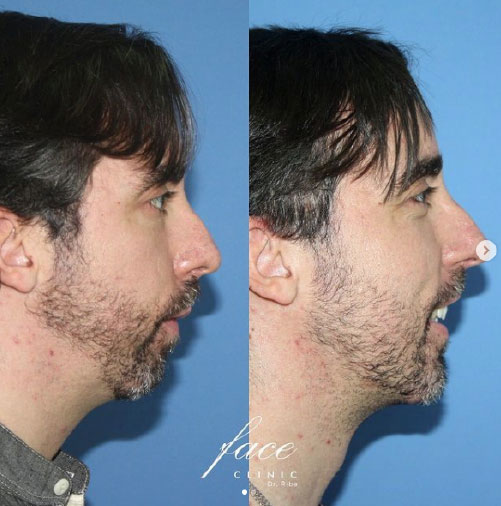
Jaw retrusion and reduced chin projection before and after
Lower-face projection

Clinical case with reduced projection of the lower third of the face and subsequent treatment outcome.

Jaw retrusion before and after, second clinical case
Facial profile balance

Outcome in a patient with reduced lower-face projection following individually planned treatment.


BENEFITS OF A CHIN IMPLANT

How chin projection can influence the whole profile

When appropriately indicated and carefully planned, an implant can change not only the chin but the way the whole profile is perceived. The aim is to improve proportion and definition while preserving the patient’s natural features.

Greater chin projection

Provides a structural increase in forward projection where the chin is under-developed.

More balanced profile

May improve the visual balance between the nose, lips and chin when the deficit is concentrated in the lower third.

Better lower-face definition

Appropriate projection can create a clearer transition between the chin, jawline and neck.

Three-dimensional correction

When indicated, personalised designs can address not only projection but also width, lateral extension and asymmetry.

Long-term structural change

Unlike resorbable options, an implant is intended to provide a long-term structural change, although revision or removal may be required if complications occur.

Can form part of a combined plan

In selected patients, it may form part of broader facial planning alongside rhinoplasty, jaw surgery or other procedures.

PLANNING AND SAFETY IN CHIN SURGERY

The key is not choosing an implant, but choosing the right operation

The outcome of chin implant surgery depends on the diagnosis, surgical approach, implant design, position on the bone and follow-up. We therefore first establish whether an implant is the right technique and also explain the alternatives and relevant risks.

+
Diagnosis

Profile, bone & bite

✓
Design

Tailored to anatomy

◎
Options

Implant or bone surgery

◇
3D

Custom implants

↗
Follow-up

Post-op review

CHIN IMPLANT SPECIALISTS

Pioneers in personalised 3D implants

Chin surgery requires an understanding of the relationship between the chin, jaw, bite and the rest of the facial skeleton. Face Clinic’s oral and maxillofacial surgery team assesses each case to select the most appropriate technique and implant type.

Dr Francisco Riba García, specialist in personalised chin implants at Face Clinic
Medical Director

Dr Francisco Riba García

Founder and Medical Director of Face Clinic. Oral and maxillofacial surgeon with more than 25 years of experience and a particular focus on facial surgery, 3D planning and personalised facial implants.

ICOMEM 28375865

View medical profile

Oral and maxillofacial surgery unit

Dr Matías Cuesta Gil, oral and maxillofacial surgeon at Face Clinic

Dr Matías Cuesta Gil

Oral and maxillofacial surgery · Assessment of facial surgery and maxillofacial conditions.

View profile
Dr Eduardo Monteserín Martínez, oral and maxillofacial surgeon at Face Clinic

Dr Eduardo Monteserín

Oral and maxillofacial surgery · Facial surgery and maxillofacial treatment planning.

View profile
Dr Gema Arenas de Frutos, oral and maxillofacial surgeon at Face Clinic

Dr Gema Arenas de Frutos

Oral and maxillofacial surgery · Assessment and comprehensive management of maxillofacial conditions and facial surgery.

Book

PATIENTS TREATED AT FACE CLINIC

What our patients say about their experience

Hear from patients treated at Face Clinic about their experience of assessment, surgery and follow-up.

Every case is different: one patient’s experience and outcome cannot predict another patient’s result.

Testimonial from a patient treated at Face Clinic

A patient shares their experience after treatment at Face Clinic.

Second testimonial from a patient treated at Face Clinic

Patient testimonial about the care pathway, procedure and subsequent follow-up.

FREQUENTLY ASKED QUESTIONS ABOUT CHIN IMPLANTS

What patients most often ask before deciding

We answer common questions about indications, surgery, recovery, risks and alternatives. The final recommendation is made after assessing the patient’s profile, bone structure and goals.

Is a chin implant the same as genioplasty?

Not exactly. Genioplasty is a broad term for surgery that changes the shape or position of the chin. It may involve an implant or an osteotomy that repositions the patient’s own bone. Before chin surgery, it is therefore important to determine which technique best addresses the underlying anatomy.

Do “chin implant” and “chin surgery” mean the same thing?

In everyday language, the terms may be used interchangeably when referring to chin augmentation with a prosthesis. Medically, however, the technique should be specified because chin surgery can also refer to bony genioplasty, reduction procedures or other operations.

How do I know whether I need a chin implant or jaw surgery?

An under-projected chin does not always mean the problem is limited to the chin. If there is overall mandibular retrusion, a bite problem or a skeletal discrepancy, advancement genioplasty or orthognathic surgery may need to be considered. Clinical examination and imaging help distinguish between these situations.

What types of chin implant can be used?

Options include preformed implants, such as certain medical-grade silicone prostheses, and personalised 3D-designed implants made from materials such as PEEK or titanium. The choice depends on the anatomy, the correction required and the surgeon’s treatment plan.

What anaesthesia is used, and is an overnight stay required?

In many cases, surgery can be performed as a day-case procedure under local anaesthesia with sedation monitored by an anaesthetist. General anaesthesia may be considered for more complex procedures or when surgery is combined with other operations. The anaesthetic plan is individualised.

How long does recovery take?

Initial recovery is usually concentrated within the first one to two weeks, although swelling can persist for longer and the contour continues to evolve. Return to work, exercise and a normal diet depends on the surgical approach and each patient’s recovery.

Is a chin implant permanent?

Chin implants are used as a long-term structural solution and are not resorbable. This should not be interpreted as a guarantee of lifelong permanence: in some circumstances, the implant may need to be reviewed, repositioned, replaced or removed.

What are the risks of chin implant surgery?

As with any surgical procedure, complications can occur. Reported risks include infection, bleeding or haematoma, altered sensation, asymmetry, implant displacement or malposition, unfavourable scarring and the need for revision surgery. The specific risks are discussed before surgery.

How much does a chin implant cost?

The cost depends on the type of implant, the level of customisation, the planning required, the type of anaesthesia and whether it is combined with other surgery. A personalised quotation is provided after assessment, together with information about finance options where available.

Can a chin implant improve the appearance of a double chin?

Greater chin projection may improve the visual angle between the chin and neck in some patients, but it does not remove submental fat or correct significant skin laxity. If these are the main concerns, specific treatments should be assessed.

FACE CLINIC LOCATIONS

Find your nearest Face Clinic

Choose the clinic that is most convenient for your first assessment. The team will review your profile, chin anatomy and surgical indication; the setting for surgery will be confirmed according to the procedure and the requirements of your case.

PERSONALISED ASSESSMENT

Would you like to know whether a chin implant is the right option for you?

Request an assessment at Face Clinic so we can review chin projection, facial profile, the relationship with the jaw and bite, and determine whether a standard implant, a personalised 3D prosthesis or another surgical technique is more appropriate.

Request an assessment Facial assessment, individual surgical indication, explanation of alternatives and risks, and a personalised quotation.