
Cheek implants
Cheek implant surgery is designed to improve the structural projection of the midface, correct asymmetry and redefine the cheekbone through personalised planning and, where indicated, a custom 3D design.
WHAT ARE CHEEK IMPLANTS?
Cheek implants, also known as malar implants, are solid prostheses surgically positioned over the malar region to alter its structural projection and definition. They may be considered when the cheekbone is under-projected, when there is facial asymmetry, or when additional structural support is needed in the midface.
Unlike fillers, which add volume to the soft tissues, an implant rests on the underlying bone. The indication therefore depends not simply on wanting “more cheekbone”, but on establishing whether the deficiency is genuinely structural and assessing how it relates to the orbit, cheeks, nose, chin and jaw.
In selected patients, custom 3D cheek implants can be designed from medical imaging. This planning allows the shape and projection of the implant to be adapted to the anatomy of each side of the face, which can be particularly useful where there is asymmetry or a very specific structural correction is required.
WHEN TO CONSIDER CHEEK IMPLANTS
Malar implants are considered when the main issue is the structure and projection of the cheekbone rather than simply superficial volume loss. Facial assessment and imaging help determine whether there is a genuine surgical indication.
When there is limited bony projection in the malar region and the midface appears flat or poorly defined from the front, profile or three-quarter view.
Differences in shape or projection between the two sides may require different implant designs to improve facial balance.
When limited malar support affects the proportions of the area between the orbit, cheek and upper jaw.
In selected cases, planning can assess cheekbone projection together with the transition into the cheek to avoid an isolated or disproportionate result.
Congenital asymmetry, trauma or previous surgery may require more precise planning and, in selected cases, custom implants.
For patients seeking a change in malar support who understand the difference between surgery and temporary soft-tissue treatments.
HOW CHEEK IMPLANTS ARE PLACED
The surgical process begins well before the operating theatre. Clinical assessment, imaging and planning are used to define the projection to be corrected, select the implant and prepare a procedure tailored to the patient’s anatomy.
We assess malar projection, symmetry and the relationship with the orbit, cheeks, nose, chin and jaw, together with the patient’s medical history and goals.
Where required for planning, imaging allows us to assess the bony support and obtain the anatomical information needed to select or design the implant.
For custom cases, the implant can be digitally designed in 3D to fit the bony surface, with each side planned independently where asymmetry is present.
The implant is positioned in the planned plane and stabilised according to the chosen technique. In many cases access can be intraoral; the anaesthetic technique and surgical setting are individualised according to the procedure and the patient.
After surgery, swelling and a feeling of tightness are expected; some patients may also experience bruising or temporary changes in sensation. Follow-up appointments allow recovery to be monitored and the result to be assessed once the tissues have stabilised.

Dr Francisco Riba explains how custom 3D facial implants are planned and designed around each patient’s anatomy.
BENEFITS OF CHEEK IMPLANTS
Where there is an appropriate indication, a malar implant can alter midface projection at a structural level. The aim is not to add the same volume to every face, but to correct the specific deficiency while maintaining proportions that suit the rest of the face.
It can reinforce cheekbone structure where bony projection is limited and improve definition from the front, profile and three-quarter view.
Planning aims to improve the relationship between the cheekbones, cheeks, orbit and the rest of the facial proportions rather than simply enlarging one isolated area.
Each side can be planned differently where the anatomy is asymmetric, particularly with custom implant designs.
The implant acts on cheekbone support and may be considered when adding volume to the soft tissues alone does not adequately address the underlying structural issue.
In selected cases, digital 3D planning allows the implant’s shape, coverage and projection to be tailored to the individual anatomy.
Implants are intended to provide a stable structural correction, although revision or removal may be required if a medical indication arises.
PERSONALISED FACIAL PLANNING
The malar region affects the transition between the eye area, cheeks and profile. Planning therefore goes beyond choosing an implant: it assesses anatomy, symmetry and balance with other facial structures before deciding where and how much projection is appropriate.
Bone, soft tissues and facial proportions
Assessment and imaging where indicated
Custom design in selected cases
Each side may require a different correction
Review of post-operative progress
CHEEK IMPLANT SPECIALISTS
Malar implant surgery requires facial diagnosis, detailed knowledge of midface anatomy and surgical planning. At Face Clinic, facial implant cases are assessed by oral and maxillofacial surgeons with experience in facial surgery and digital planning. Below are some of the specialists within a wider medical team.

Dr. Francisco Riba García
Medical Director and founder of Face Clinic. Oral and maxillofacial surgeon with a particular focus on facial surgery, custom facial implants and digital 3D planning for the cheekbones, chin, jaw and other areas of the facial skeleton.
ICOMEM 28375865
View medical profileFacial implants and maxillofacial surgery unit

Dr. Matías Cuesta Gil
Oral and maxillofacial surgery · Facial surgery, advanced implantology and complex case planning.
View profile
Dr Blanca Duarte Ruiz
Oral and maxillofacial surgery · Implantology, bone regeneration and orthognathic surgery.
View profile
Dr Gema Arenas de Frutos
Oral and maxillofacial surgery · Facial surgery, implantology and treatment of maxillofacial conditions.
BookCHEEK IMPLANTS BEFORE AND AFTER
Cheek implant before-and-after cases should be interpreted in the context of the patient’s starting anatomy, implant design and the timing of the photograph. Post-operative swelling can temporarily alter volume and contour, so an immediate image does not represent the final result.
Request an assessment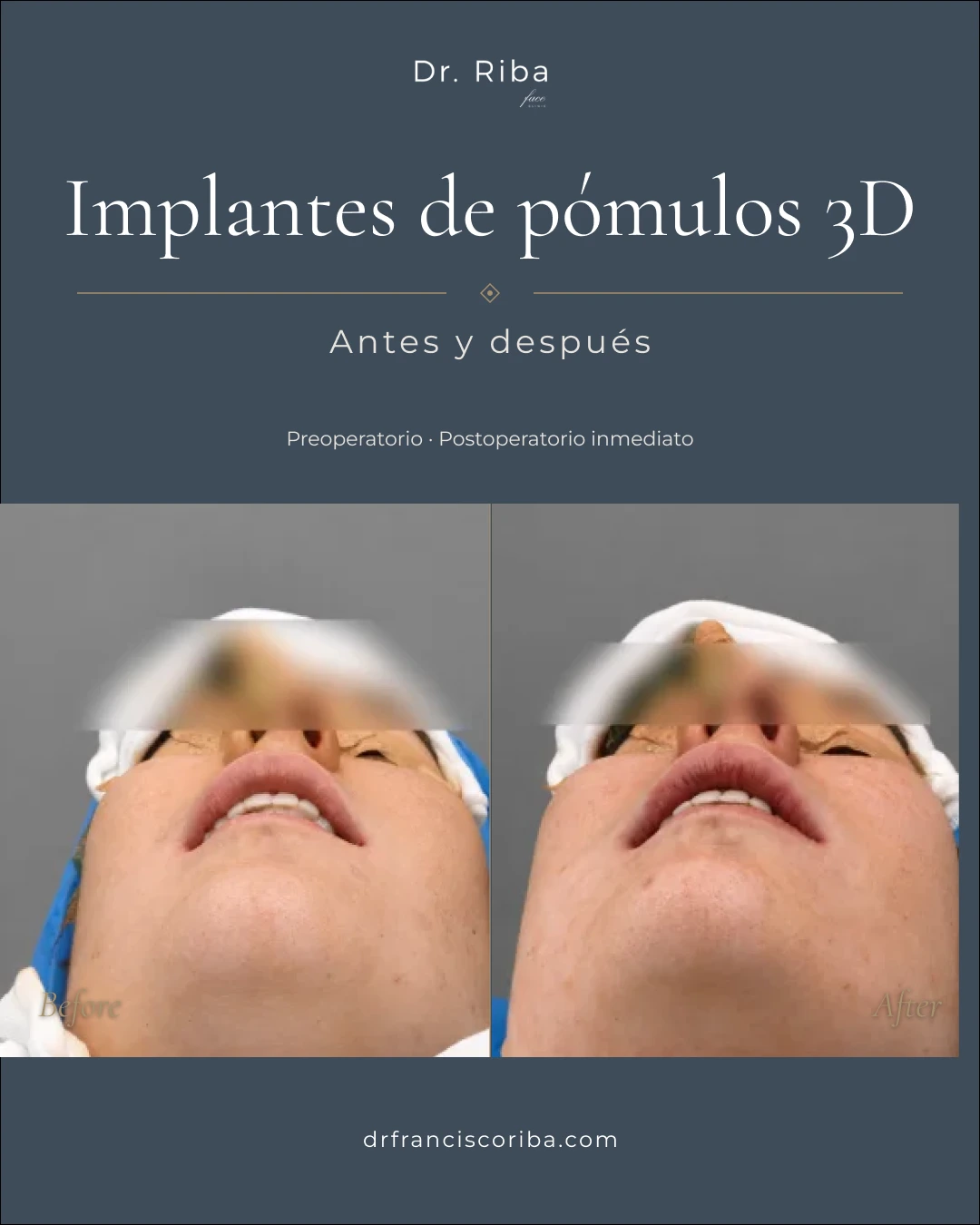
In this case, the left cheekbone had already been treated when the image taken before placement of the right implant was captured. The most useful comparison is therefore on the right side of the face, where the change in projection can be seen after implant placement. The photograph was taken in the immediate post-operative period, while swelling was still present, and does not represent the final result.

3D planning image of custom cheek implants designed for a patient. Digital planning allows the malar anatomy to be assessed and the shape, coverage and projection of each implant to be defined in advance so that they can be tailored to each side of the face.
PATIENTS TREATED AT FACE CLINIC
Other patients’ experiences can help explain what the process is like, but they cannot predict the outcome of an individual operation. Every cheek implant procedure requires personalised diagnosis, planning and follow-up.
In this testimonial, a patient describes their experience after cheek implant treatment at Face Clinic.

A patient shares their experience of cheek implant treatment at Face Clinic.
FREQUENTLY ASKED QUESTIONS ABOUT CHEEK IMPLANTS
These answers provide general guidance about malar implant surgery. The indication, implant type, anaesthesia, recovery and quotation should always be determined following an individual medical assessment.
What happens at the first cheek implant consultation?
We assess malar projection, symmetry and the relationship with the cheeks, orbit and overall facial profile, together with the patient’s medical history and goals. Where indicated, imaging is requested to complete the planning process.
How much do cheek implants cost in Spain?
There is no single fixed price. The cost depends on whether the implant is standard or custom-made, the imaging and planning required, surgical complexity, anaesthesia and whether it is combined with other procedures. Face Clinic provides an individual quotation after assessing the case.
Do “cheek implant” and “malar implant” mean the same thing?
In this context, the terms are used interchangeably. They refer to a solid implant that is surgically positioned over the malar region to alter its structural projection. The term “malar implant” is also commonly used.
How is a cheek implant placed?
The technique depends on the implant design and the patient’s anatomy. A surgical pocket is typically created over the cheekbone through the planned approach, the implant is positioned as intended and then stabilised according to the case. The surgical approach and anaesthesia are decided individually.
When can the final result be assessed?
Projection changes immediately after surgery, but early swelling makes it difficult to assess the final contour. Most swelling gradually settles over the first few weeks, and the final result should be assessed once the tissues have stabilised.
What are the risks of cheek implants?
As with any surgical procedure, possible complications include bleeding, infection, changes in sensation, persistent pain, asymmetry, implant displacement, contour irregularities or the need for revision surgery. The specialist will explain the specific risks before the procedure.
Are cheek implants suitable for men?
Yes. Cheek implants may be suitable for both men and women. Planning is not based on applying a standard shape, but on the patient’s anatomy, facial proportions and the degree and type of projection that suits their features and goals.
What is the difference between a cheek implant and a filler?
A cheek implant is a solid prosthesis that surgically alters the malar structure. A filler is injected into the soft tissues and is gradually resorbed. They are different treatments, and the choice depends on whether the main issue is structural or related to soft-tissue volume.
FACE CLINIC LOCATIONS
You can request an assessment for cheek implants at Face Clinic. The surgical indication, specialist and treatment location are confirmed after reviewing each individual case.


PERSONALISED ASSESSMENT
Request an assessment at Face Clinic so we can review malar projection, symmetry, bony anatomy and facial proportions, and determine whether standard or custom 3D cheek implants may be indicated.
Request an assessment Clinical assessment, personalised planning and information about alternatives, surgery, recovery and a quotation tailored to each case.


